


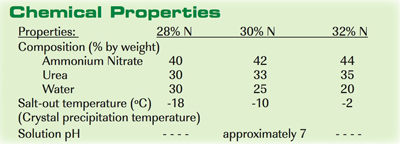
Solutions of UAN are widely used as a source of N for plant nutrition. The NO₃- portion (25 percent of the total N) is immediately available for plant uptake. The NH₄+ fraction (25 percent of the total N) can also be assimilated directly by most plants, but is rapidly oxidized by soil bacteria to form NO₃- (nitrate). Soil enzymes hydrolyze the remaining urea portion (50 percent of the total N) to form NH₄+, which subsequently transforms to NO₃- in most soil conditions.
Though UAN makes an excellent source of N nutrition for plants, since half of the total N is present as urea, extra management may be required to avoid volatile losses. When UAN remains on the surface of the soil for extended periods (a few days), soil enzymes will convert the urea to ammonium (NH₄+), a portion of which can evaporate as ammonia gas. Therefore, to avoid significant loss, UAN should not remain on the soil surface for more than several days. Inhibitors that slow these N transformations are sometimes added. When UAN is first applied to soil, the urea and the NO₃- molecules will move freely with water in the soil. The NH₄+ will be retained in the soil where it first contacts cation exchange sites on clay or organic matter. Within two to 10 days, most of the urea will be converted to NH₄+ and no longer be mobile. The originally added NH₄+ plus the NH₄+ coming from urea will eventually be converted to NO₃- by soil microorganisms.


